
I’m Helen Billows
you know what they told you about the trauma. but i know what they missed.
I'm a registered psychologist, EMDR consultant and fairly committed trauma nerd, with more than 7,000 trauma therapy sessions behind me.
I've spent years learning how to understand and treat trauma properly. Rather inconveniently, a decent chunk of that time (years, actually) involved discovering that accumulating knowledge about psychology doesn't necessarily mean understanding it, or knowing how to use and apply it well.
In fact, knowing too much and having an explanation for everything can become a problem of its own.
It's taken years of clinical training, experience and a lot of critical thinking to develop the judgement I now bring to my work.
And that's the thinking I want to share with you.
Welcome to the brain of a booked-out trauma therapist.



I didn’t start out as a trauma therapist.
My first psychology job in 2018 was in alcohol and other drug services. I was doing the counselling and CBT I'd been trained to do, but almost everyone I worked with had a significant trauma history, and many met criteria for PTSD.
I increasingly had the feeling that I was helping people manage the consequences of their trauma without being particularly well equipped to treat the trauma itself. That didn’t sit well with me.
I knew from the research that trauma therapy could be incredibly effective, and I wanted to be able to produce those kinds of outcomes consistently. So I trained in EMDR, experienced it myself during the training, thought it was brilliant, and promptly became obsessed.
Naturally, I went all in.
I was determined to become a brilliant trauma therapist.


As a novice, I trusted the sources I should have been able to trust.
I thought becoming an excellent trauma therapist meant learning as much as possible. So I read widely, trained constantly and learned from people who presented themselves as experts. They sounded knowledgeable, had impressive credentials and appeared to know what they were talking about. As a novice, I had little reason to question them. But I eventually discovered that much of what I'd learned was oversimplified, poorly supported or just plain wrong.
As a novice, I trusted the sources I should have been able to trust.
I thought becoming an excellent trauma therapist meant learning as much as possible. So I read widely, trained constantly and learned from people who presented themselves as experts. They sounded knowledgeable, had impressive credentials and appeared to know what they were talking about. As a novice, I had little reason to question them. But I eventually discovered that much of what I'd learned was oversimplified, poorly supported or just plain wrong.
Enter: Type-A psychologist obsessed with getting it right.
I knew something was missing, and I was committed to excellence, so I went back to university and completed a Master of Clinical Psychology. That's where I developed the advanced assessment and clinical reasoning skills that changed everything. I became much better at questioning assumptions, evaluating competing explanations and recognising when the evidence simply wasn't there. Turns out, sophisticated thinking isn't about having an explanation for everything. It's about having high intellectual standards and knowing what to exclude. And sometimes that means having the restraint to resist the temptation to give everyone (including yourself) a sexy, and satisfying answer.
Enter: Type-A psychologist obsessed with getting it right.
I knew something was missing, and I was committed to excellence, so I went back to university and completed a Master of Clinical Psychology. That's where I developed the advanced assessment and clinical reasoning skills that changed everything. I became much better at questioning assumptions, evaluating competing explanations and recognising when the evidence simply wasn't there. Turns out, sophisticated thinking isn't about having an explanation for everything. It's about having high intellectual standards and knowing what to exclude. And sometimes that means having the restraint to resist the temptation to give everyone (including yourself) a sexy, and satisfying answer.
And it worked.
My assessments became more accurate, my treatment more targeted, and my clinical outcomes markedly improved. I became far more selective about what information deserved my attention, let alone a place in my clinical work. Knowing what to leave out became just as important as knowing what to include. I went on to build a specialist trauma practice, deliver over 7,000 trauma therapy sessions, and become an accredited EMDR consultant and training facilitator. The biggest lesson? Excellent judgement beats having all the answers.
And it worked.
My assessments became more accurate, my treatment more targeted, and my clinical outcomes markedly improved. I became far more selective about what information deserved my attention, let alone a place in my clinical work. Knowing what to leave out became just as important as knowing what to include. I went on to build a specialist trauma practice, deliver over 7,000 trauma therapy sessions, and become an accredited EMDR consultant and training facilitator. The biggest lesson? Excellent judgement beats having all the answers.
I soon realised the same problem was happening outside of the therapy room:
everyone is learning a lot about trauma. but more information is not necessarily better.
psychological explanations and trauma ideas can sound very convincing even when there’s little evidence they actually apply.
normal emotions get pathologised. trauma responses become ‘intuition’. genuine problems can be dismissed as “just a trigger”.
and when you’re up to your eyeballs in explanations and theories, it gets even harder to understand what’s actually going on.
In January 2026 I launched The Trauma Nerd Podcast…
I bring the knowledge and clinical reasoning developed through 7,000+ trauma therapy sessions to the concepts, questions and trauma rabbit holes that deserve a closer look.
We challenge familiar assumptions, untangle misunderstood concepts and get into the details that could completely change how you think about the things you’ve learned about trauma.
Less cliché therapy speak. More "oooooh, THAT makes sense."
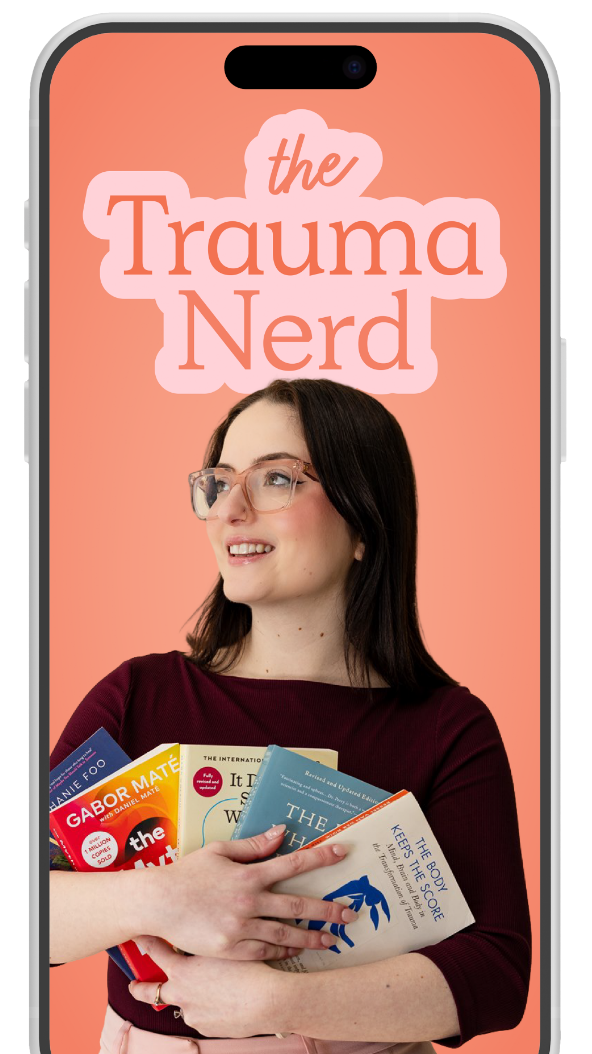




Outside the therapy room…
I’m an Adelaide Hills local, a pilates regular, and mum to a now-toddler who has strong opinions about everything.
He fits right in.
My credentials
7,000+ sessions delivered.
Across trauma, PTSD, complex trauma and personality disorders. This is not generalist work. Trauma is the entire focus.
Registered Psychologist.
Registered with the Psychology Board of Australia since 2018.
EMDRAA-Accredited EMDR Therapist and Consultant.
The highest level of EMDR accreditation available in Australia, held by a small number of psychologists nationally.
EMDR Training Facilitator.
Selected to assist in delivering EMDR training programs across Australia by national training providers Psychology Training and EMDR Therapy Training Australia. One of a small number of clinicians chosen to teach other therapists how to do this work.
PSYBA-Approved Psychology Supervisor.
Approved to provide formal supervision to trainee psychologists.
Eight years of university training.
Including a Master of Clinical Psychology, the highest level of clinical postgraduate qualification in the field. Completed with a perfect GPA.
Private Psychology Practice Owner.
I own Billows Psychology, a high-demand 1:1 clinical consulting practice with an exclusive focus on EMDR and trauma therapy.
A near-decade of continuous investment.
In specialised training, ongoing EMDR supervision, and clinical education.
A career built around asking better questions before accepting easy answers.
Which is exactly what I want to help you do, too.




My approach
I create resources for people who want more than another psychological explanation.
I’m less interested in giving you another label for what you’re experiencing than helping you work out whether that label actually fits. Because the goal isn’t to interpret everything through trauma. It’s to understand what’s actually happening.
I don't oversimplify. I don't soften the psychology to make it more palatable. I assume you're capable of understanding complex ideas, and I trust you enough to give you the real version.
That means no filler, no wellness platitudes, and no advice I wouldn't firmly stand behind in the therapy room.
I'm honest, I'm kind, and I'm dedicated to genuinely helping.
Click to flip through